BEHIND THE SCENES · COVER STORY
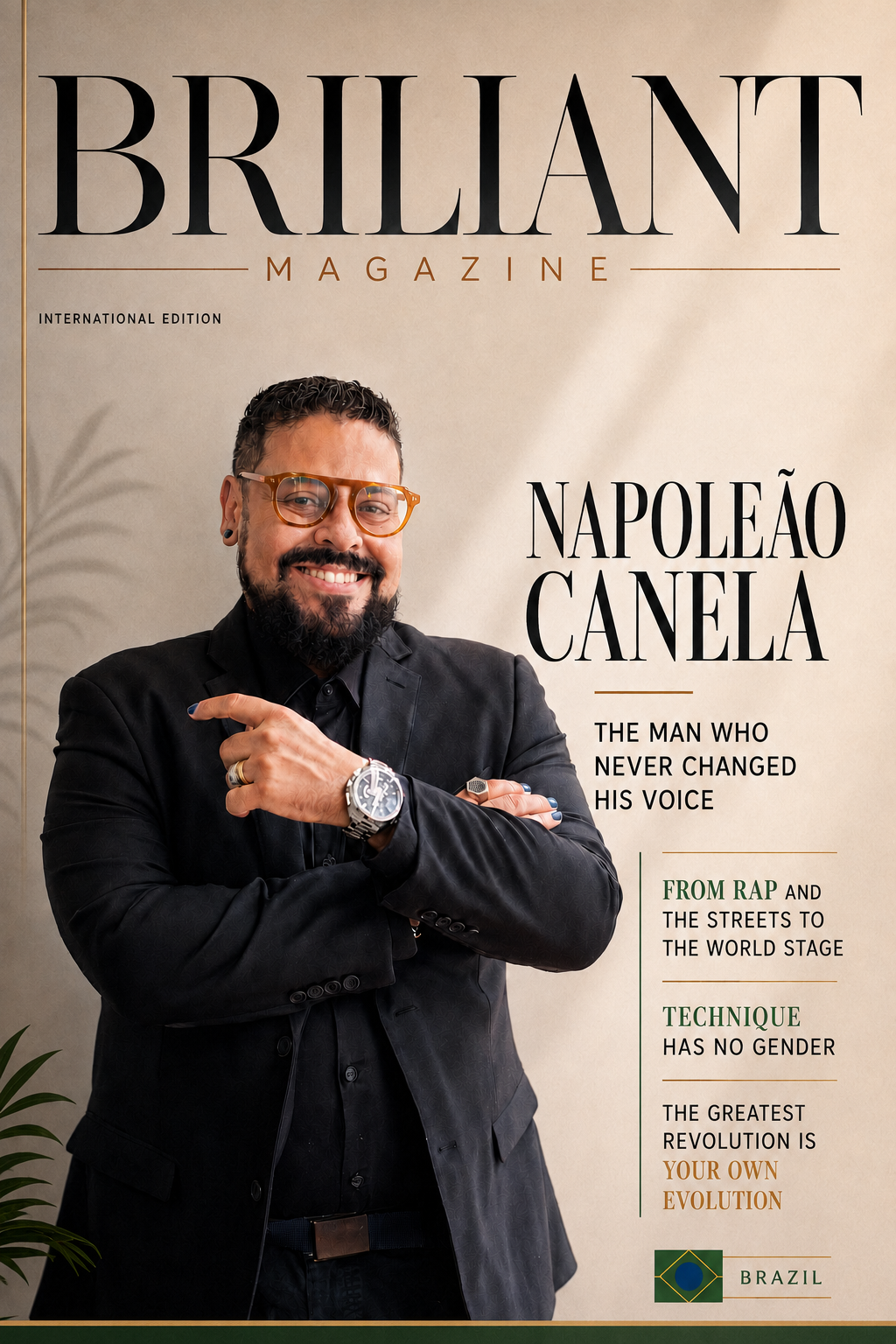
From RAP and the unforgiving reality of the streets to the international stages of the nail industry, Napoleão Canela transformed survival into precision, prejudice into fuel, and education into his legacy.
By BRILIANT MAGAZINE Editorial Team
For Napoleão Canela, luxury does not begin beneath spotlights, on an international stage, or with the applause that follows a victory. It begins early in the morning, at home, with a good coffee prepared without hurry, his wife Angela beside him, and the familiar sound of a cavaquinho carrying a samba through the room.
To many, this might seem like an ordinary day. To a man born in the basement of an upholstery workshop, surrounded by rats and raised within the unforgiving reality of daily survival, it is anything but ordinary. Peace, when it has been hard-earned, becomes a form of triumph.
Away from courses, competitions, journeys and the title of “Master,” Napoleão describes himself as a simple, grounded man. Somewhere within him, the boy of skateboarding and RAP is still very much alive. The difference is that the boy who once searched for a way to change the world has now found the peace he spent years trying to reach.

This is not simply the story of a man who became successful in the nail industry. It is the story of a man who crossed worlds without abandoning his identity — who transformed scarcity into ambition, prejudice into fuel and knowledge into a legacy, while refusing to change the voice that had carried him from the streets.
BORN BELOW GROUND
Long before the stages, the international titles and the classrooms filled with students, Napoleão’s understanding of the world was shaped by scarcity.
He was born in the basement of an upholstery workshop, in circumstances that left little room for romantic interpretations of childhood. He remembers living among rats and facing what he describes as a daily war for survival. It is an image almost impossible to reconcile with the confident figure who now travels internationally, speaks before professional audiences and stands alongside some of the most respected names in his industry.
Yet that distance between where he began and where he stands today is essential to understanding him.
Napoleão does not measure success in the way the market might measure it. Recognition, stages and awards may have made his name increasingly visible, but they have not changed the point from which he views his life. He still sees the world through the eyes of someone who was given very few opportunities and learned early that, if a door did not exist, he would have to build one himself.
“For someone who came from nothing, every achievement already means being ahead,” he says. “I had almost no opportunities. I had to create them.”
His father’s greatest dream was to own a home — a dream his parents would only fulfil later in life. That history gave material security a powerful meaning for Napoleão, but it also taught him its limits. Owning a home could provide safety. It could prove that a cycle had been broken. But it could not, on its own, define the value of a life.
The basement gave him more than a difficult beginning. It gave him a permanent reference point — one that would prevent success from becoming entitlement and would make an ordinary, peaceful day feel like something extraordinary.
BEFORE NAILS, THERE WAS RAP

Before precision became part of his professional language, there was rhythm. Before the manicure table, there was the skateboard, the cavaquinho and the uncompromising voice of RAP.
Napoleão’s earliest identity was built far beyond the beauty industry. The street was not simply a backdrop to his youth; it was a school of observation, discipline and consequence. As a RAP producer, he wanted his music to awaken people. His songs confronted uncomfortable realities because those realities were not abstract subjects to him — they belonged to a world he knew intimately.
He experienced the pain of losing friends who had followed destructive paths. Music became a way to speak about what he witnessed, to give shape to anger and to tell truths that were often easier for society to ignore.
At that time, revolution meant reaching other people through words and sound. But as the years passed, Napoleão came to understand that the first life he needed to transform was his own.
“The greatest revolution I could create was my own evolution,” he says.
When nails eventually entered his life, he did not leave that earlier self behind. He redirected it. The intensity that had once driven his music became commitment. The discipline learned through hardship became professional focus. The perseverance required to survive became the force that pushed him to study, compete, travel and teach.
Those who know him closely understand that the foundations of his life have remained remarkably clear: his wife, Angela; his profession; and samba. The settings may have changed, but the personality has not. Whether on the street, behind a microphone, at a manicure table or on an international stage, Napoleão has resisted the temptation to become a more convenient version of himself.
His authenticity is not an accessory to his career. It is the source of its strength.
A KIOSK, AN IMPOSSIBLE RENT AND A CHOICE
In 2012, Napoleão took over a small nail kiosk from his sister. Looking back, it would be tempting to describe that moment as the beginning of a carefully imagined career. The reality was far less certain — and far more urgent.
He had very little money in his bank account and an extraordinarily high shopping-centre rent waiting to be paid at the end of the month. There was no grand vision of becoming a celebrated nail professional, no certainty of international stages and no carefully designed personal brand.
There was simply the need to survive.
“At the beginning, I did not imagine that I would become a manicurist,” he recalls. “I was thinking only about survival. My concern was to sell, not specifically to do nails.”
Yet beneath that immediate pressure was a conviction that would eventually define his journey. Although he could not imagine the professional he would become, he believed completely in the possibility of changing his destiny through his own business.
The kiosk was small, but the decision contained something much larger. It was an act of ownership over a life that had offered him few ready-made opportunities. The same man who had learned to confront difficult realities through RAP was now confronting another kind of reality: rent, responsibility and the uncertainty of building something from almost nothing.
Success did not begin with applause. It began with a bill that had to be paid, a business that had to work and the refusal to accept that his beginnings should determine his ending.
THE MAN WHO REFUSED TO FIT IN
Entering a predominantly female industry as a man would already have made Napoleão visible. Entering it with the experience of the street, an unmistakable personal style and no intention of reshaping himself to satisfy other people’s expectations made him impossible to ignore.
The prejudice was real. So was the feeling of displacement.
His presence generated suspicion, and the unspoken question seemed to follow him: did someone like him truly belong in this world?
For Napoleão, the most difficult period was not learning a technique or mastering an instrument. It was the period of affirmation — facing disapproving looks, beginning again from zero and repeatedly having to demonstrate that his value was greater than the assumptions made about him.
Whenever someone suggested that he did not fit the accepted image of the profession, he responded by working harder. Rejection did not persuade him to retreat; it intensified his determination.
He could have softened his voice, adjusted his appearance or adopted the posture expected of him. Instead, he made his difference his greatest strength.
“I am the same Napoleão in every environment,” he says. “I do not change my tone or my posture according to the occasion. I know my presence makes many people uncomfortable — and I use that as fuel.”
Eventually, the balance shifted. Technique and knowledge became impossible to dismiss. Recognition followed, placing him alongside respected professionals and proving what he had believed from the beginning: ability has no gender.
Discrimination has not entirely disappeared. What has changed is its power over him. It no longer makes him question his place. It accelerates his desire to expand it.
Napoleão did not earn acceptance by becoming easier for the industry to understand. He earned respect by becoming too skilled to overlook — without lowering his head, changing his style or surrendering the identity that had carried him there.

FOREVER IN STUDENT MODE
For Napoleão, becoming an educator was never permission to stop learning. It was a greater responsibility to continue.
He describes remaining a student as a conscious decision against complacency. In his view, the moment a teacher believes there is nothing left to learn is precisely the moment that teacher stops growing.
Entering what he calls “student mode” keeps him alive within the profession. It also changes the way he teaches. The questions raised by his students are not interruptions to a prepared lesson; they are opportunities to refine how knowledge is explained, demonstrated and ultimately understood.
Throughout his career, Napoleão has sought to learn directly from the source. During his Staleks training, Anna Popova gave him an encouragement that remained with him: she told him that he would become a great educator. The revolutionary chemical perspective of Antônio Sacripante expanded the way he understood the science behind the profession.
His search for knowledge later took him as far as Siberia, where he continued his development at OZA Art School. Studying with masters including Artem Manicure, Viktoria Klopotova and Marcelo Merlino helped redefine not only his technique, but also his professional posture.
Travelling across the world to learn required more than financial investment. It required the willingness to place himself repeatedly in the position of a beginner — to listen, question, observe and accept that authority does not depend on pretending to know everything.
“Humility does not diminish the authority of an educator,” he says. “It builds it.”
That belief now forms part of the education he passes forward. Napoleão does not want his students simply to reproduce a movement or memorize a procedure. He wants them to understand that excellence is never a finished state. It is a discipline renewed each time a professional chooses curiosity over certainty and growth over comfort.
TECHNIQUE HAS NO GENDER
Napoleão’s professional identity cannot be contained within a single role. He moves between the realities of an entrepreneur, a working nail professional, a competitor and an international lecturer. Yet one principle connects them all: innovation must remain inseparable from technical mastery.
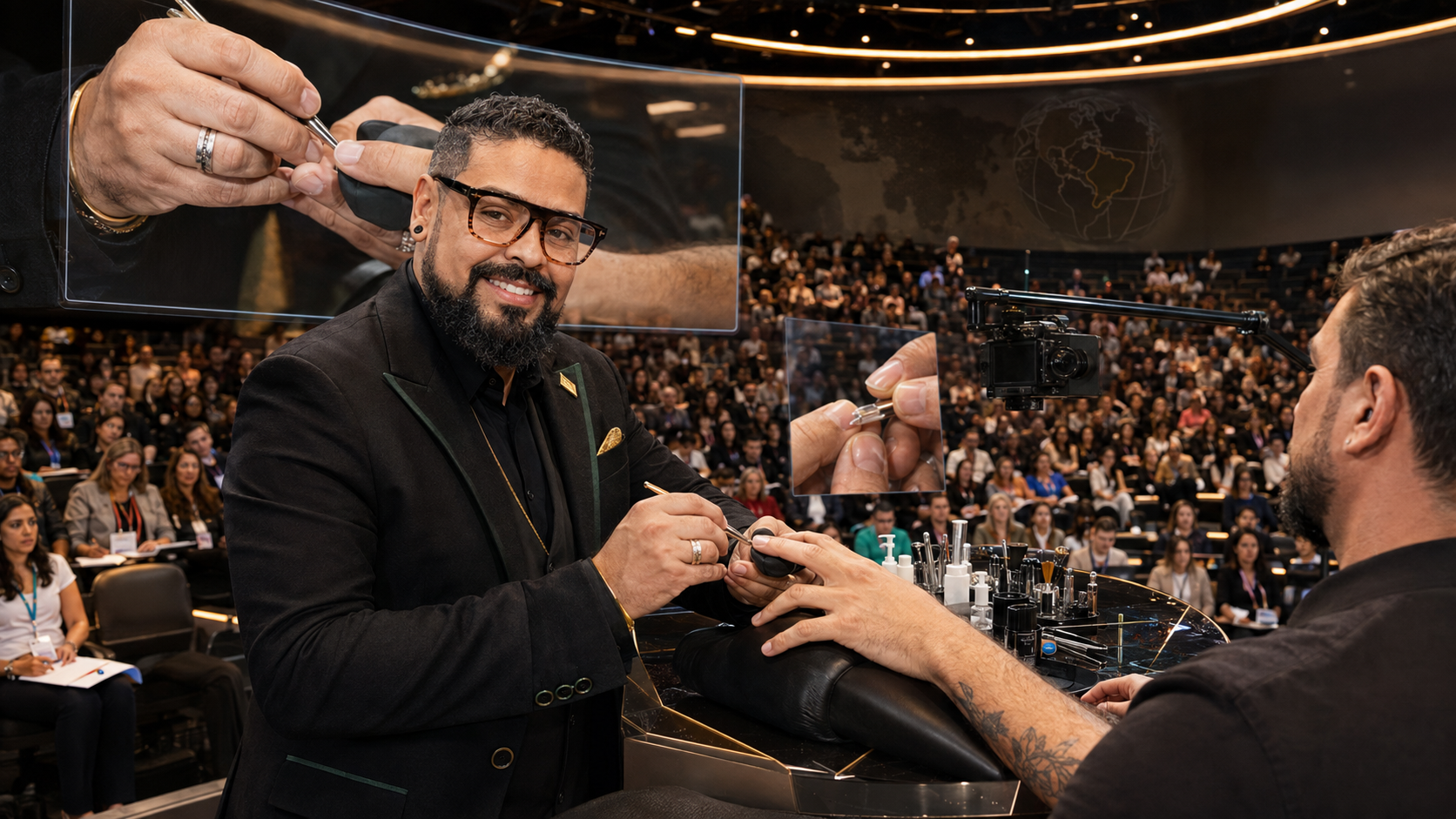
His authority begins at the manicure table. Precision, for Napoleão, is not a decorative ideal or a performance reserved for competition. It is a professional discipline built through repetition, observation and a deep understanding of every movement.
His work with cuticle precision, salon manicure and male manicure has become central to his professional signature. These are fields in which the smallest details matter — where control, safety, aesthetics and knowledge must exist in complete balance.
As a lecturer, he has deliberately introduced subjects that challenged familiar boundaries within the market, including ozonated oils and male manicure. He did not approach these subjects as temporary trends, but as areas deserving greater technical depth, professional respect and serious education.
As a competitor, he placed his own work under the scrutiny of demanding international juries. The titles that followed, including his BRILIANT Cup victory in 2026, demonstrated his versatility across salon techniques and confirmed that the standards he teaches are standards he is prepared to defend through his own performance.
But awards alone do not define his signature.
What makes a piece of work unmistakably Napoleão Canela is the union of two qualities: an uncompromising pursuit of aesthetic precision and an ability to translate complex knowledge into teaching that can genuinely change another professional’s career.
For him, excellence has never belonged to one gender, one background or one predetermined image of who is permitted to succeed in the beauty industry. Technique responds to discipline. Knowledge responds to curiosity. Authority is built through work.
“The game changed when I demonstrated that technique and knowledge have no gender,” he says.

It is a conviction born from personal experience, but its meaning extends far beyond his own story. Every precise movement at the table becomes part of a larger argument: professional value is not inherited from society’s expectations. It is constructed, practised and proven.
NOT “JUST MANICURISTS”
Beyond every drill bit, pair of scissors or lesson in chemistry, there is something Napoleão insists his students must carry with them: an awareness of their own value.
Technique can be trained. Procedures can be repeated. Precision can be improved through practice. But, in his view, the posture a professional adopts toward life is what ultimately separates those who remain trapped by circumstances from those who build authority and shape their own market.
Napoleão understands the social tendency to diminish professions practised with the hands. He came from a reality of extreme scarcity and knows how easily people can internalize the idea that their work is somehow smaller, less intellectual or less worthy of respect.
He wants that belief to end in his classroom.

“I want them to leave knowing that they are not ‘just manicurists,’” he says. “They are high-performance professionals, artists and people capable of transforming their own reality.”
This is why his teaching extends beyond the correct use of an instrument. He speaks about discipline, professional posture, courage and the responsibility that comes with knowledge. The street taught him not to surrender easily. The classroom taught him that resilience can be passed forward when it is transformed into a method, a message and an example.
He encourages his students to resist predetermined limits, to use difficulty as fuel and to remain humble enough never to abandon “student mode.” Confidence, in his philosophy, must never become complacency. Authority must be supported by continuous growth.
Most importantly, he wants professionals to recognize the power they carry in their own hands — not only the power to create technically excellent work, but the power to earn independence, dignity and control over their future.
If his students leave with that understanding, Napoleão believes his role as an educator has been fulfilled.
THE SEED HE WILL LEAVE BEHIND
For many years, the dream of owning a home carried the weight of an entire family history.
It had been his father’s greatest ambition — something Napoleão’s parents achieved only later in life. When he acquired his own home at the age of 28, it represented far more than a material purchase. It was evidence that a cycle of insecurity could be broken.
Yet success also taught him that possessions have limits. A home can provide safety. Financial stability can offer freedom from the fear that once shaped daily life. But neither can answer the deeper question of what a person will leave behind.
Napoleão and his wife, Angela, chose not to have children. That decision led him to consider legacy in a different way.
“Because my wife and I chose not to have children, I understood that the true seed I can leave for eternity is knowledge,” he says.
Education became more than a profession. It became continuity.
Every student who discovers the value of their own work, every professional who achieves independence and every career transformed through knowledge becomes part of something that can outlive titles, stages and trophies.
When Napoleão imagines the year 2036, he does not want his name to be remembered only as that of a champion or an international lecturer. He wants to be remembered as the man who challenged prejudice and raised the technical level of his profession — someone who helped transform salon nails and cuticle precision into disciplines treated with the seriousness of science and the refinement of elite art.
The legacy he envisions is also a declaration: this profession has no gender, no ceiling and no obligation to conform to predetermined standards in order to deserve respect.
He wants the next generation to look at the distance between the basement, the Fiorino delivery vehicle and the international stage, and understand that the prejudice of others can never be greater than their own technical commitment.
By 2036, his greatest source of pride would not be the number of awards carrying his name. It would be knowing that thousands of people had found greater independence, dignity and confidence because education gave them the tools to transform their own lives.
That is the future he is building — one student at a time.
HIS GREATEST LUXURY
If the Napoleão of today could sit face-to-face with the young man who once made deliveries in a Fiorino, produced RAP and had no idea where life would take him, he would not tell him to become someone different.
He would tell him to endure.
“Stay strong and do not change a single part of your essence,” he would say. “All the rushing, the exhaustion and the pain of witnessing the harsh reality of the street are preparing you to become unshakable. Keep working hard and do not be afraid of uncertainty, because your truth will take you to places you cannot yet imagine.”
And what would that younger Napoleão say if he could see the man standing before him today?
He imagines a quiet smile before the answer:
“You did not sell yourself. You earned our place, travelled the world and gained the respect of some of the greatest names in the industry. You did not have to lower your head or change your style to get there. I am proud that our essence remains intact.”
Perhaps this is the most revealing measure of his success.
Not the titles. Not the stages. Not even the distance travelled from the basement to international recognition. It is the knowledge that he crossed that distance without abandoning the person who began the journey.
Today, when there is no class to teach, no competition to enter and no audience expecting “Master Napoleão Canela,” happiness becomes beautifully uncomplicated. A good coffee prepared without hurry. Angela beside him. A cavaquinho in his hands. Samba filling the room while time is allowed to move slowly.
For someone whose childhood was defined by survival, peace is not an absence of ambition. It is evidence that the struggle created something worth protecting.
The boy who once wanted to change the world through RAP did, in the end, create a revolution. It simply began where the most enduring revolutions often do — within himself.